
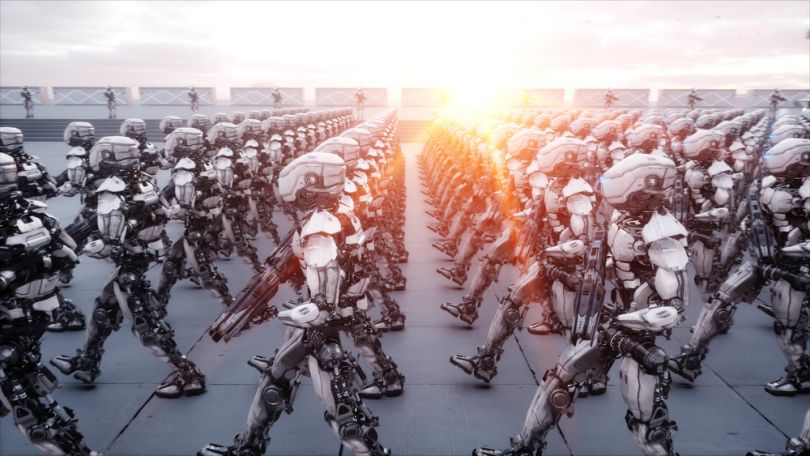
Robots could brainwash children and trigger war with humans, says Europol
Europol's 48-page document envisions a dystopian Europe where robots seamlessly integrate into daily routines, from gliding through shopping centers to delivering parcels to high-rise apartments and cleaning public transport platforms under the cover of night.
As automation displaces workers in urban deprived areas, frustrations boil over into riots, with crowds engaging in "bot bashing" against the machines that have taken their jobs. Seemingly minor incidents, such as a hospital care robot administering the wrong medication, quickly escalate into national scandals.
These events amplify populist sentiments, sparking widespread calls to "put people first" and heightening societal divisions. Meanwhile, cyber criminals target AI-powered social care robots designed for children and vulnerable adults. By hacking these systems, attackers could reprogram the robots' empathetic features to extract personal data or even groom victims for illicit activities.
As the report cautions, "The empathetic capabilities of social robots might, in the future, be abused by criminal and terrorist actors for a variety of malicious activities." Building on this, terrorists leverage technology salvaged from the Ukraine war to deploy swarms of pocket-sized AI quadcopters, aiming to disrupt city power grids, water supplies, or facilitate prison escapes.

Already, Mexican cartels and Islamist groups utilize inexpensive drones for their operations, prompting law enforcement to adopt countermeasures like net-firing guns and lasers in countries including the UK, Belgium, China, and Australia. In response, human-robot collaboration is poised to become essential in policing, enabling joint efforts in emergency responses, searches, and evidence gathering.
However, as robots assume routine tasks like patrolling and traffic management, they may replace officers, fostering resentment within the ranks. Further complications arise in investigations, where seized robots might escape custody, and interrogating machines—such as determining intent in driverless car accidents—proves inherently challenging.
The report draws on real incidents to illustrate these risks, including a 2022 chess robot in Russia that fractured a seven-year-old opponent's finger. Colombian authorities recently intercepted a Starlink-guided submarine transporting 1.5 tonnes of cocaine toward Europe, highlighting autonomous systems in crime. In California, police stopped a driverless vehicle for an illegal U-turn during a DUI check, underscoring emerging enforcement dilemmas.

Criminals increasingly employ drones for smuggling, surveilling drug labs, and launching attacks on police or rivals, with pilots advertising their services online to gang leaders.
Both Chinese and Indonesian forces are already incorporating robotic technologies into their operations. Europol emphasizes that while it "can’t predict the future," the report aims to anticipate plausible scenarios to inform current decisions.
Experts like Denis Niezgoda view full Robocop-like integrations as unlikely by 2035, citing technical and regulatory obstacles. He argues that robots fill labor voids driven by Europe's aging populations, alleviating dull, dirty, and dangerous duties from human workers.
Nevertheless, the proliferation of cheap drones from the Ukraine war could lead to inter-drone confrontations between criminals and law enforcement.